 Prazamana
H-GLASS Robotic Cell 3 Safety Upgrade
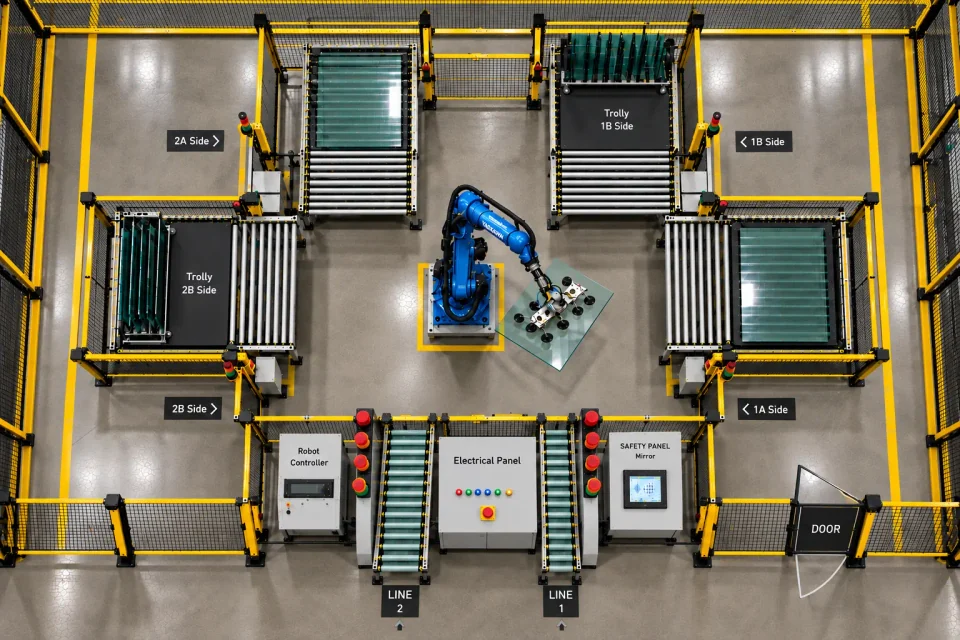
The H-GLASS Robotic Cell 3 had four open pallet access points, no external safety boundary, and no Safety PLC integration — leaving personnel exposed to the robot, pallet, and roller conveyor from any side of the cell. Here's what we found — and the solution we engineered.
The Project
The cell pairs a robot handling pick-and-place operations with pallet in/out movement across four access points — 1A, 1B, 2A, and 2B — and a roller conveyor system. A pre-project hazard review walked the cell end to end and found fifteen distinct ways a person could be exposed to hazardous motion, from open access on any of the four sides to a complete absence of Safety PLC integration. Every modification below was implemented specifically against one or more of these findings.
Hazards Identified15
Safety Systems Integrated5
The Challenge
A pre-project hazard review of the cell found 15 distinct ways personnel could be exposed to hazardous motion.
In short, the cell exposed personnel to
Uncontrolled Robot & Roller Movement
Unexpected or continued movement of the robot arm, gripper, and roller conveyor could strike, trap, or crush personnel working in or near the cell.
Open Access From Four Sides
The 1A, 1B, 2A, and 2B pallet access points weren't safety-controlled, letting personnel — or a person riding the pallet itself — enter the hazardous area from any side.
Incomplete Safety Control
With no presence detection, interlocking, or accessible Emergency Stop, a hazardous condition could go undetected and a safe stop couldn't be guaranteed.
All 15 hazards, in detail
Robot Movement Hazard
The robot arm moves at high speed during pick and place operations. Unexpected or uncontrolled movement can cause serious impact, collision or crushing injuries.
Direct Access to Hazardous Area
The robotic cell had four access points: 1A, 1B, 2A and 2B. Personnel could potentially enter the hazardous robot operating area during machine operation.
Pallet In/Out Hazard
During pallet loading and unloading, personnel could enter between the roller conveyor sections. This could result in trapping, crushing or serious injury.
Person Entering with Pallet
A person could sit or stand on the pallet and enter the robotic cell along with the pallet. This could expose the person directly to the moving robot.
Robot Impact and Crushing Hazard
A person inside the cell could be struck by the robot arm, gripper or other moving mechanisms. This could result in severe impact, crushing or fatal injury.
Roller Conveyor Hazard
Moving rollers and conveyor mechanisms could create trapping, crushing and pinch-point hazards. Hands, feet or other body parts could become caught between moving components.
Four-Side Access Hazard
The 1A, 1B, 2A and 2B access points were not adequately safety-controlled. Personnel could approach or enter the hazardous zone from any of these sides.
Lack of Emergency Stop
Emergency Stop devices were not adequately provided at the required access locations. In an emergency, stopping the robot and conveyor could therefore be delayed.
Lack of Safety Interlocking
The access points were not fully interlocked with the robot safety circuit. The robot could potentially continue operation while an access point was open.
Lack of Presence Detection
Adequate personnel presence detection was not available inside the hazardous area. A person could remain inside the cell without being detected before robot operation.
Unexpected Start-Up Hazard
The robot or conveyor could start unexpectedly after reset, power restoration or a control command. This could result in sudden movement and serious injury.
Pinch and Crushing Points
Pinch and crushing points existed around the robot, gripper, pallet, rollers, fixtures and mechanical components. Personnel could suffer hand, leg or body injuries.
Automatic Cycle Hazard
The robot could continue its automatic pick and place cycle while a person was inside the hazardous area. This created a significant risk of collision, trapping or crushing.
Maintenance and Intervention Hazard
Manual intervention, troubleshooting or maintenance inside the cell could expose personnel to unexpected machine movement. Safe isolation and controlled access were not adequately integrated.
Incomplete Safety Integration
The cell did not have complete safety integration covering guarding, access control, E-Stops, interlocking and personnel protection. This resulted in a high risk of serious or fatal accidents.
Access Detection — External Light Curtains & Mirrors
- Installed external light curtains at the pallet entry and exit areas, creating a safety boundary outside the robotic cell that detects intrusion and initiates a safe stop.
- Combined light curtains with mirrors to form a continuous protective border around the roller conveyor and pallet movement areas, rather than a single guarded point.
- Extended this safety protection to all four pallet access sides — 1A, 1B, 2A, and 2B.
Pallet & Roller Interlocking
- Integrated the external light curtain boundary with the pallet/roller control system, so roller movement stops if the boundary is interrupted during loading or unloading.
- Interrupting the boundary while the pallet is exiting the cell stops the robot through the safety circuit, protecting personnel positioned outside.
- The same boundary prevents a person from entering the cell together with the pallet, since interruption stops the hazardous movement before it can continue.
Safety PLC Integration & Signal Feedback
- Integrated a Safety PLC to process every safety-device signal and generate the required safe-stop commands when a hazardous condition is detected.
- Connected the Safety PLC to the machine PLC through the required communication interface, coordinating safety status with machine control.
- Monitored feedback from light curtains, Emergency Stops, and door safety devices, triggering a safe response the moment any device reports an unsafe condition.
- Commanded the relevant motors to stop through the safety circuit whenever a safety boundary is interrupted or an Emergency Stop is activated.
- Incorporated the robot's own healthy/safety status signal into the safety control system, so the robot is monitored as part of the overall machine safety loop.
Reset & Restart Prevention
- Added a healthy-status indication that clears the moment the safety boundary is interrupted, giving a clear signal that conditions are no longer safe.
- Added a reset function so the machine cannot resume operation until the required safety conditions are restored and the reset procedure is completed.
- Designed the logic so restoring a light curtain or door doesn't by itself restart hazardous movement — the full reset sequence must be satisfied first.
Emergency Stop & Door Monitoring
- Installed new Emergency Stop push buttons at the required locations around the robotic cell for immediate, accessible stopping.
- Added an additional Emergency Stop near the door/access area so personnel entering or working near it can stop the machine quickly.
- Incorporated a safety door switch into the safety system, so opening the door is detected and prevents or stops hazardous operation.
- Installed external light curtains at the pallet entry and exit areas, creating a safety boundary outside the robotic cell that detects intrusion and initiates a safe stop.
- Combined light curtains with mirrors to form a continuous protective border around the roller conveyor and pallet movement areas, rather than a single guarded point.
- Extended this safety protection to all four pallet access sides — 1A, 1B, 2A, and 2B.
The Result
Overall, the H-GLASS Robotic Cell 3 hazards were addressed by integrating external light curtains and mirrors around all four pallet access sides, pallet/roller safety interlocking, a Safety PLC with full signal feedback and machine communication, Emergency Stop and door monitoring, and reset and restart-prevention logic — separating personnel from the robot, pallet, and roller operating area on every side of the cell.
Related Solutions
Facing Similar Hazards in Your Facility?
Tell us about your cell or line and we'll walk it the same way — hazard by hazard.