 Prazamana
Robotic Cell Safety Upgrade
A robotic doffing and wrapping cell had multiple ways for personnel to be exposed to robot motion, a rotating wrap shaft, and unauthorized access — including a light curtain that didn't stop the machine when interrupted. Here's what we found — and the solution we engineered.
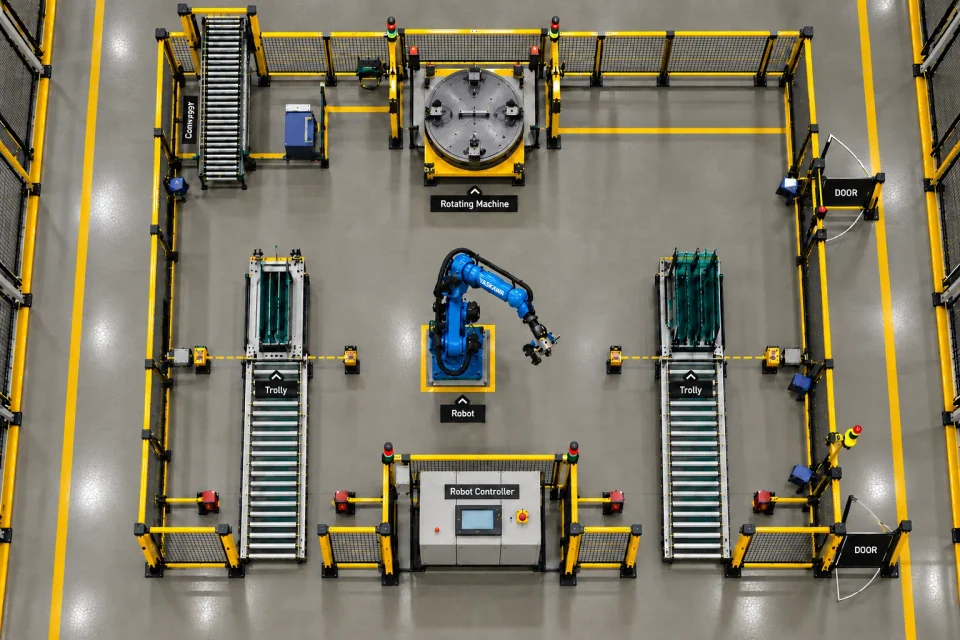
The Project
The cell pairs a robot handling doff pick-and-place at two trolley entry points — 1A and 1B — with a rotating-arm wrapping station. A pre-project hazard review walked the cell end to end and found six distinct ways a person could be exposed to hazardous motion, from simple unauthorized entry to a light curtain that failed to stop the machine when it was interrupted. Every modification below was implemented specifically against one or more of these findings.
Hazards Identified6
Safety Systems Integrated5
The Challenge
A pre-project hazard review of the cell found 6 distinct ways personnel could be exposed to hazardous motion.
In short, the cell exposed personnel to
Robot Arm Movement
Unexpected or uncontrolled movement of the robot arm can cause serious impact or crushing injuries to personnel entering the hazardous area.
Light Curtain Hazard
Incorrect positioning or insufficient height of the light curtain may allow personnel to crawl underneath or bypass the detection zone.
Access During Automatic Operation
Unauthorized or uncontrolled access to the robotic cell during automatic operation can expose personnel to multiple mechanical and crushing hazards.
All 6 hazards, in detail
Unauthorized Access — Side 1
A person could enter the robotic cell along with or behind the trolley while the robot was operating, creating a risk of serious injury.
Unauthorized Access — Side 2
A similar access hazard was identified on Side 2, where a person could enter the robot operating area during trolley movement.
Person Trapped Inside the Cell
During maintenance or doff removal, a person could remain inside the cell while another operator closes the door, resets the safety system, and starts Auto mode — risking unexpected robot movement and a serious or fatal accident.
Robot Pick-and-Place Hazard
During the doff pick-and-place operation, personnel could be exposed to robot movement and the rotating shaft, creating a collision or crushing hazard.
Rotating Shaft / Wrapping Hazard
During the wrapping process, the rotating shaft with the wrapping roll could come into contact with the operator's face or head, creating a serious struck-by or entanglement hazard.
Light Curtain Failure
The light curtain was installed for operator protection; however, the machine did not stop when the light curtain was interrupted — a critical safety-function failure.
Access Detection — Light Curtains & Radar Sensors
- Installed light curtains at the 1A and 1B trolley entry points to prevent unauthorized human access.
- Installed radar sensors at the 1A and 1B entry areas for additional human-presence detection.
- Installed an additional radar sensor near the main safety door entry to detect personnel entering the hazardous area.
- Installed a fourth radar sensor further along the 1B line to provide additional access protection.
- Installed hand-protection light curtains at the rotating arm/wrapping area to prevent operator hand access during machine operation.
- Increased the light curtain protection depth by 200 mm to provide additional protection against head and hand injuries.
Physical Guarding
- Provided fencing around the rotating arm machine to physically restrict access to the hazardous rotating area.
Safety PLC & VFD STO Integration
- Integrated all safety devices with the Safety PLC and VFD STO circuit to achieve a safe stop during safety-device interruption.
- Programmed the safety logic so that interruption of any safety device immediately stops the robot and rotating machine.
- When the trolley-entry light curtain is active and interrupted by a person, the VFD STO is activated and the robot healthy/enable signal is removed.
- Integrated the safety logic for the safety door, 1A entry, 1B entry, and rotating-machine light curtain so that any interruption stops the hazardous motion.
- Integrated muting, STO, safety reset, emergency stop, and trolley entry/exit safety logic into the Safety PLC program.
Trolley Muting Logic
- Implemented light curtain muting logic during trolley entry and exit to allow safe trolley movement without unnecessary machine trips.
- Configured the system so that once the trolley reaches its end position and is locked, the corresponding entry light curtain becomes active.
- Configured the radar sensors to remain muted during normal trolley operation and become active when the relevant safety device is interrupted.
Restart Prevention & Safe Reset
- Programmed the system so that after a safety interruption, the radar sensors become active and detect any person remaining inside the hazardous area.
- Implemented restart prevention logic so that the machine cannot restart if a person is detected inside the robotic cell.
- Improved the safety reset system so that the machine can be safely reset from designated reset locations near 1A, 2A, and the rotating-machine area.
- Verified the safety sequence to ensure that robot and machine motion cannot restart while a person remains inside the hazardous area.
- Installed light curtains at the 1A and 1B trolley entry points to prevent unauthorized human access.
- Installed radar sensors at the 1A and 1B entry areas for additional human-presence detection.
- Installed an additional radar sensor near the main safety door entry to detect personnel entering the hazardous area.
- Installed a fourth radar sensor further along the 1B line to provide additional access protection.
- Installed hand-protection light curtains at the rotating arm/wrapping area to prevent operator hand access during machine operation.
- Increased the light curtain protection depth by 200 mm to provide additional protection against head and hand injuries.
The Result
Overall, the identified robotic-cell hazards were addressed through light curtains, radar sensors, fencing, Safety PLC logic, VFD STO, muting logic, reset logic, and restart prevention.
Related Solutions
Facing Similar Hazards in Your Facility?
Tell us about your cell or line and we'll walk it the same way — hazard by hazard.