 Prazamana
Stop Time Measurement Testing
Measuring a machine's real stopping performance to calculate the safety distance a guard or light curtain needs, per ISO 13855.
What Does Stop Time Measurement Testing Cover?
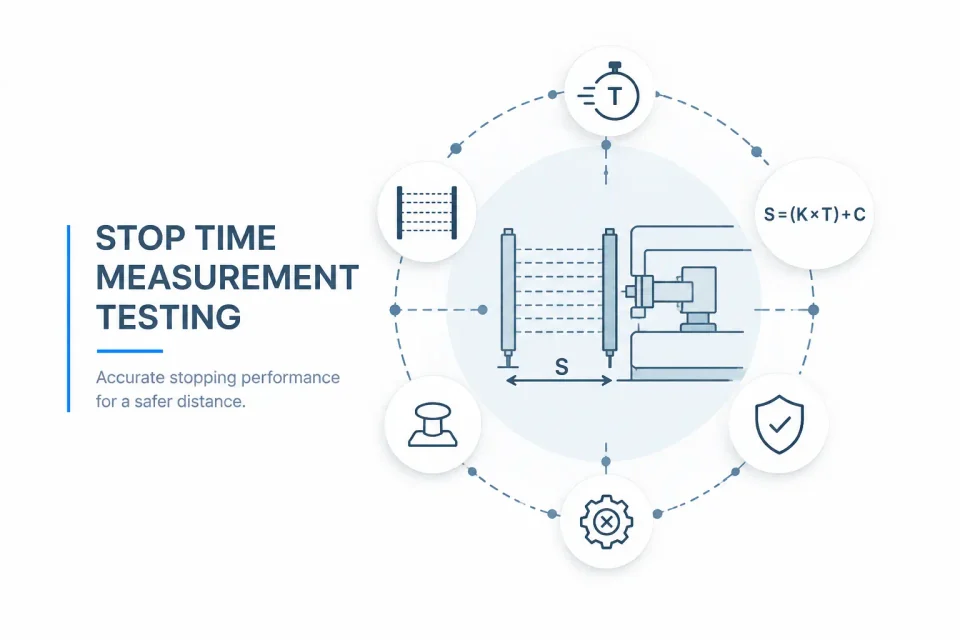
Stop time measurement determines the overall stopping performance of a machine — the real-world time between a safeguard being triggered (e.g. a light curtain, interlocked guard, or E-stop) and all hazardous motion actually ceasing. This measured value is the critical input to the ISO 13855 safety-distance formula, S = (K × T) + C, which calculates the minimum distance a safeguard must be positioned from the hazard zone.
Why Does It Matter?
A safety distance calculated from an assumed or theoretical stop time is not a safety distance — it's a guess. If the real stopping time is longer than assumed, a light curtain or interlocked guard can be positioned too close, meaning a person's hand or body can reach the hazard before the machine has actually stopped moving. Getting this measurement right is what turns a safeguard from a checkbox into an actual, physical guarantee of safety.
Scope
Stop Time Measurement applies wherever a safeguard's position depends on how fast a machine actually stops.
- Stopping-performance measurement under worst-case conditions using calibrated instrumentation
- Minimum safety distance calculation per ISO 13855 (S = (K × T) + C)
- Verification of existing or proposed guard, light curtain, or safety mat positioning
Standards
ISO 13855 sets the safety-distance formula that a machine's measured stopping performance feeds into.
- Safety Distance Standard
- ISO 13855
Stop time measurement determines the overall stopping performance of a machine — the real-world time between a safeguard being triggered (e.g. a light curtain, interlocked guard, or E-stop) and all hazardous motion actually ceasing. This measured value is the critical input to the ISO 13855 safety-distance formula, S = (K × T) + C, which calculates the minimum distance a safeguard must be positioned from the hazard zone.
Related Solutions
Need Stop Time Measurement Testing?
Tell us about the machinery and its safeguards and we'll scope the measurement.